Back to top
Article8 min read
Image
Section-Heading.png
Image
Section-Heading.png

Female patients are particularly impacted by chronic rheumatic diseases, with a lower quality of life and a higher burden of disease.1–6 Women are increasingly choosing to start a family later in life; however, treatments to control rheumatic diseases are often started at a younger age.7

It is therefore critical that disease remission is achieved to prevent disease progression, maintain quality of life and aid optimal foetal outcomes.8–14 Despite this importance, many patients do not feel accurately informed about their treatment options during their childbearing years.7,15

Timely shared decision-making discussions enable women of childbearing age to make informed choices regarding treatment options, taking into account potential disease outcomes and future plans.7,16–19 Find out more about how you can address these unmet needs to help improve treatment outcomes for your female patients.


Image
Section-Heading.png
Image
Section-Heading.png

HEAR FROM THE EXPERTS


Achieving clinical remission for your female patients of childbearing age


with Prof. Andreoli

Achieving and maintaining clinical remission for women of reproductive age accommodates diverse reproductive goals and timelines.7

Prof. Laura Andreoli discusses the increased burden of disease for women of childbearing age with chronic rheumatic diseases, including the implications of not achieving clinical remission in these patients. Prof. Andreoli explores strategies to help these patients achieve clinical remission, highlighting the importance of proactive family planning discussions which can facilitate a treat-to-target treatment strategy. 

VideoEmbed.png
 

“It's important to plan today for tomorrow, so it means that achieving remission as early as possible.

Prof. Laura Andreoli

University of Brescia, Brescia, Italy

Knowing future plans of your female patients could improve their treatment outcomes


Understanding the future plans of female patients is important for improving treatment outcomes, especially as diagnosis and treatment for axSpA, RA and PsA tend to overlap with their reproductive years.7,16,19

However, there exists a notable gap in patient education, as many women report feeling inadequately informed about their treatment options.7,15 Engaging in timely discussions can inform patients about their treatment options and facilitate a shared decision-making process that aligns with their current health needs, as well as their future plans.7,16–19

Image
illustration.png

HEAR FROM EXPERTS

The importance of future planning with female patients with chronic rheumatic diseases


with Dr Oseme Etomi


Watch the interview video below, as Dr Oseme Etomi examines the importance of discussing future plans with female patients who have
chronic rheumatic diseases. In her answers, Dr Etomi: 

  • Elaborates on the key stages in the female patient journey where conversations regarding treatment management should take place 
  • Explains the importance of early dialogue to ensure patients have all
the required, and accurate, information to help make an informed treatment decision 
  • Emphasises the importance of clinical data in helping guide these vital conversations and facilitate a shared decision-making process between the clinician and patient, ensuring patient choices are informed and compatible with future pregnancies 
VideoEmbed (1).png
 

“It's really important for us to tell these patients the right information at the beginning and then checking at various time points within that treatment journey.”

Dr Oseme Etomi

Guy's and St Thomas' Hospital, London, United Kingdom

Image
Section-Heading.png
Image
Section-Heading.png

Bridging the information gap
for your female patients


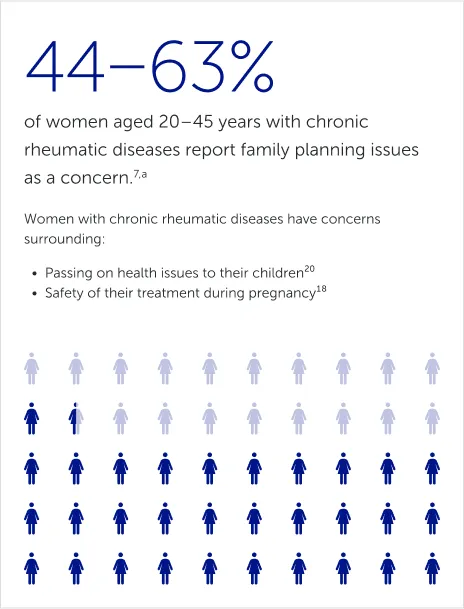
Women aged 18–45 with chronic rheumatic diseases often have limited information on how to best manage their condition throughout their lives.20

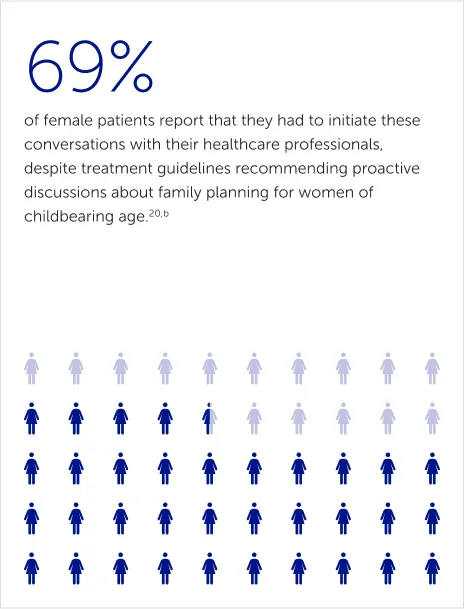
Early shared decision-making is crucial for women with chronic rheumatic diseases, including identifying the risks and benefits of treatment. By initially guiding informed choices, future interventions can be minimised. Without these conversations, women may potentially delay pregnancy, face treatment concerns or avoid treatment altogether during pregnancy.12,17,19,20
Image
Image.png
Image
Image.png
Image
Image.png
Image
StatBoxFeatured_Landscape copy.png

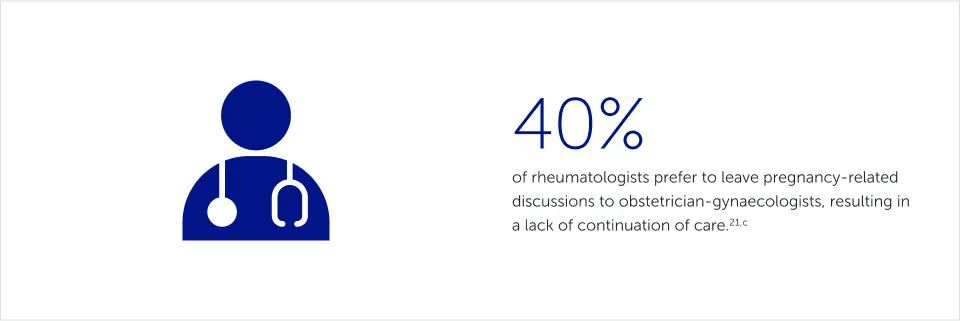
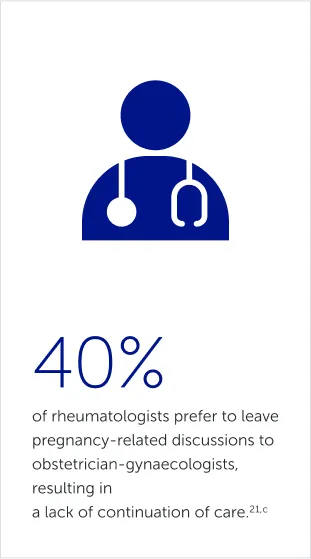
Greater awareness of family planning in disease management could improve shared decision-making conversations, ensuring a more integrated approach that better meets the needs and priorities of your female patients during their reproductive years.18,21,22

FREE E-LEARNING COURSE

Clinical communication strategies with GRAPPA to improve patient outcomes


Guidelines recommend shared decision-making across rheumatology, which is proven to improve patient satisfaction and adherence to treatment.9,17,22–24 Communicating with patients is key to the patient-clinician collaboration, yet this can be challenging in an increasingly complex treatment landscape.9,17,22–24

The Group for Research and Assessment of Psoriasis and Psoriatic Arthritis (GRAPPA) have developed a skills-based e-learning course for healthcare professionals working in rheumatology to improve consultation skills.27

Gain valuable insights into effective clinical dialogue that can positively impact your daily practice. The 60-minute course delves into the importance of active listening, offers techniques to master clinical communication and presents
a clinical case to apply these skills in practice.27 Hear from fellow healthcare professionals as
they share their experiences and takeaways from the course. 


This course was funded by an unrestricted education grant from UCB

Image
card-testimonial.png
Image
card-testimonial (1).png
Image
card-testimonial (2).png
Image
card-testimonial (2).png
Image
Featured icon.png


GRAPPA course

The e-learning course is available to GRAPPA and non-GRAPPA members alike, so please share with your colleagues and others in patient care roles.


Image
Image.png

Other articles you might like


Recommended Articles


You can read more articles that might interest you.

Want to see more articles?


Can’t find the answer you’re looking for? See all the Resources we have.

GL-DA-2500783

Date of preparation: October 2025

Footnotes

a) A multinational survey of 969 female patients of childbearing age with chronic inflammatory disease (axial spondyloarthritis [axSpA], Crohn's Disease [CD], psoriatic arthritis [PsA], RA, systemic lupus erythematosus [SLE], ulcerative colitis [UC]) across Europe and the USA.7 

b) A multinational online survey of 1,052 women of childbearing age, where 622/1,052 participants had a chronic rheumatic disease (RA, axSpA, PsA). Data reported are from a subset of patients with moderate-severe chronic rheumatic diseases who were pregnant or had been pregnant in the past 2–5 years from Germany, France, the UK, Italy, Spain, the USA and Japan.20 

c) A multinational mixed-methods study (semi-structured interviews and a survey) of 173 rheumatologists across Germany, the UK and the USA.21

References

  1. Lee W, et al. Ann Rheum Dis. 2007;66(5):633–638.
  2. Tournadre A, et al. Arthritis Care Res (Hoboken). 2013;65(9):1482–1489.
  3. Slobodin G, et al. Clin Rheumatol. 2011;30(8):1075–1080.
  4. Eder L, et al. Ann Rheum Dis. 2013;72(4):578–582.
  5. Nas K, et al. Mod Rheumatol. 2021;31(4):869–874.
  6. Rusman T, et al. Curr Rheumatol Rep. 2018;20(6):35.
  7. Chakravarty E, et al. BMJ Open. 2014;4(2):e004081.
  8. Clowse MEB, et al. Arthritis Rheumatol. 2018;70(9):1399–1407.
  9. Coates LC, et al. Nature Rev Rheumatol. 2022;18(8):465–479.
  10. Landewé RBM, et al. Ann Rheum Dis. 2020;79(7):920–928.
  11. Ostor AJ, et al. Adv Ther. 2022;39(1):75–93.
  12. Russell MD, et al. Rheumatology (Oxford). 2023;62(4):e48–e88.
  13. Brouwer J, et al. Ann Rheum Dis. 2015;74(10):1836–1841.
  14. Smeele HTW, et al. Semin Arthritis Rheum. 2019;49(3s):S32–S35.
  15. Tanaka Y, et al. Rheumatol Int. 2023;43(4):721–733.
  16. Kavanaugh A, et al. Arthritis Care Res (Hoboken). 2015;67(3):313–325.
  17. Sammaritano LR, et al. Arthritis Rheumatol. 2020;72(4):529–556.
  18. Wolgemuth T, et al. Arthritis Care Res (Hoboken). 2021;73(8):1194–1200.
  19. Gottlieb AB, et al. Int J Womens Dermatol. 2019;5(3):141–150.
  20. Tincani A, et al. Annals of the Rheumatic Diseases. 2018;77(Suppl 2):866. Abstract FRI0693.
  21. Murray S, et al. BMJ Open. 2021;11(6):e043960.
  22. Förger F, et al. Ann Rheum Dis. 2024;83(Suppl 1):2075–2076. EULAR 2024. Abstract AB1439.
  23. Fraenkel L, et al. Arthritis Rheum. 2021;73(7):1108–1123.
  24. Morrison T, et al. Semin Arthritis Rheum. 2022;56:152041.
  25. Asan O, et al. PLoS One. 2021;16(2):e0247583.
  26. Smolen JS, et al. Ann Rheum Dis. 2023;82(1):3–18.
  27. GRAPPA. Available from: https://elearn.grappanetwork.org/login.aspx?action=warn&ReturnUrl=%2f. Accessed: September 2025.

Abbreviations

AI: Artificial intelligence; axSpA: Axial spondyloarthritis; CD: Crohn’s Disease; GRAPPA: Group for Research and Assessment of Psoriasis and Psoriatic Arthritis; PsA: Psoriatic arthritis; RA: Rheumatoid arthritis; SLE: Systemic lupus erythematosus; UC: Ulcerative colitis; UK: United Kingdom; USA: United States of America. 

How relevant is this content to you?
Not relevant
Highly relevant
Help us deliver more relevant content to you
Published on